


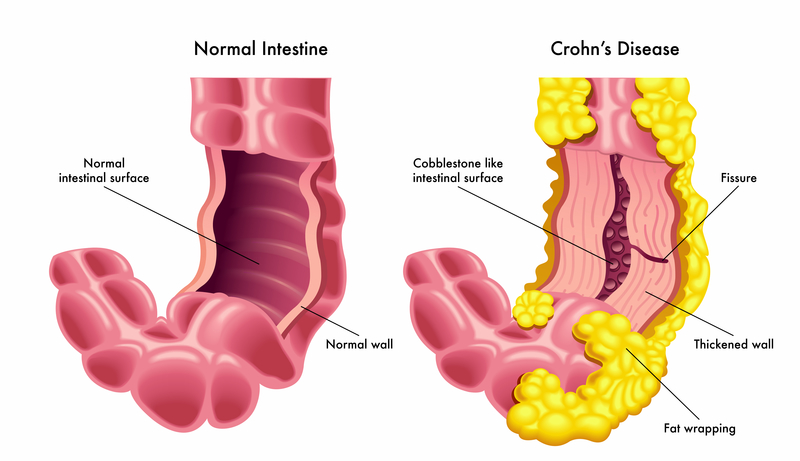
Crohn’s Disease is a chronic inflammatory disease of the intestines, especially the colon and ileum, associated with ulcers and fistula.
CD affects the intestines, creating scarring and ulcers all throughout which leads to thinning of the intestines and inflammation. This causes very severe pain for most Crohn’s patients and makes it difficult to eat, sometimes anything at all. This disease is an autoimmune disease, meaning our immune systems are attacking the intestines and our own body. This creates a major problem because our immune system seems to think that our intestines are an infection or parasite, when it’s not. This can lead to many complications within the body.
- CD= Crohn’s Disease
- DB= Double Bubble
There are many different types of medications to help with Crohn’s. Some are biologics, like Remicade for example. Those are considered chemotherapy drugs. I currently am on a pill and have infusions where every 8 weeks for the rest of my life I will go to an Oncology center and they stick an IV in me, and pump medicine (Remicade) into my body for a few hours. The goal of this is to eventually put my body into remission, meaning the pain wont be as sever and I will be able to eat more food.
Flare Ups: A flare up is when a sudden intensification of disease symptoms occur in your body, causing inflammation, abdominal pain, frequent/urgent bowel movements, vomiting, bloody stool, or even times where you can’t eat anything because it hurts so bad. Flare’s can last anywhere between days to months. Some people have to be hospitalized for flares, like myself.
One thing about CD is that no one knows what causes it. Some people can go their whole lives without it and then all of a sudden at age 42, they find out they have it. It appears out of nowhere and the cause is unknown, which can be very frustrating.
To be diagnosed with Crohn’s, a GI (Gastroenterologist) doctor will usually perform a colonoscopy where a scope/camera will go up your rectum and weave its way through your intestines. MRI’s and CT scans can also see inflammation, along with blood work.
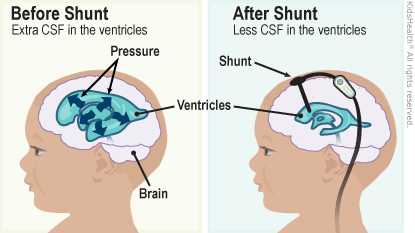
Hydrocephalus a condition in which fluid accumulates in the brain, typically in young children, enlarging the head and sometimes causing brain damage.
Hydrocephalus is basically just excess fluid in the brain that refuses to drain properly. In my case, my child has a lot of fluid surrounding his brain and needed a shunt system placed after birth, to drain the fluid and to prevent more from accumulating. The shunt will be placed there for his entire lifespan. It’s basically a hollow tube that will go from his brain to his abdomen, to drain the fluid down there.
Shunt: 1) To move a body fluid, such as cerebrospinal fluid, from one place to another. 2) A catheter (tube) that carries cerebrospinal fluid from a ventricle in the brain to another area of the body. A shunt may be placed to relieve pressure from hydrocephalus, for example.http://medicinenet.com
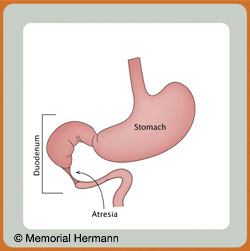
Double Bubble (Duodenal Atresia) is the congenital absence or complete closure of a portion of the lumen of the duodenum. It causes increased levels of amniotic fluid during pregnancy (polyhydramnios) and intestinal obstruction in newborn babies. https://en.wikipedia.org/wiki/Duodenal_atresia
So basically, my son also has what is called duodenal atresia or, as many call it a double bubble formed. His bowels were disconnected and when he was born, they had to perform surgery to reconnect them. As a result of this, he had a G-tube placed for the first year of his life.
G-Tube is a tube that is inserted into the abdomen, directly into the stomach. It looks like a a little button near the belly button and has a cap connected to it where when it is time for feeding, you connect a much longer tube that leads up to an IV bag of sorts and you place the child’s liquid food (whether that be formula, breast milk, etc) inside and it slowly makes its way into the stomach. Most people with G-tubes do not eat or drink orally, but not all have G-tubes placed for forever. It truly depends on the circumstances.
 Crohn's Chronicles